


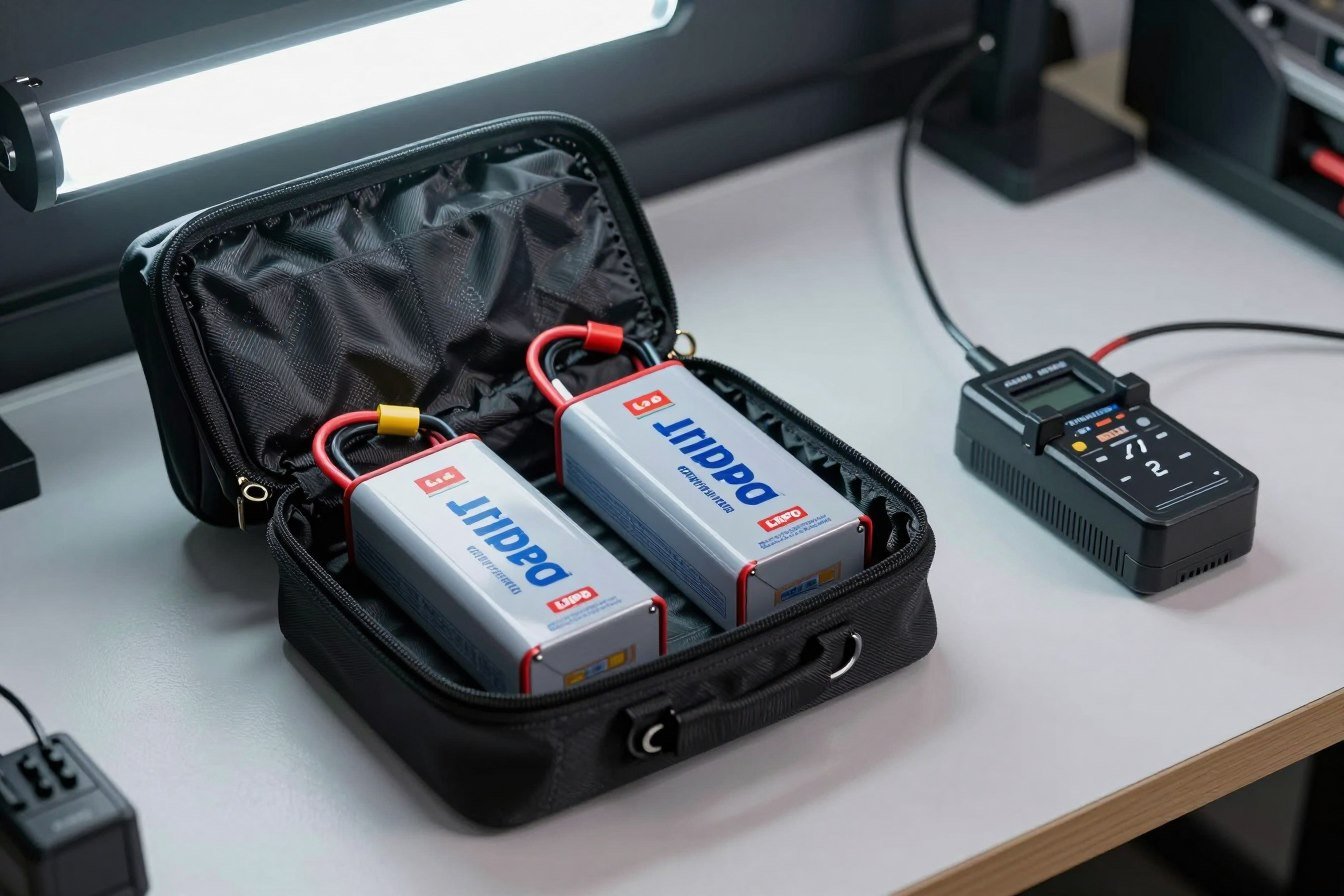

Every LiPo pack carries the same four numbers, and once you can read them the rest of the hobby gets cheaper: you stop buying packs that are too small, and you stop killing the ones you own.
How to read a label
Take 2200 mAh 4S 14.8 V 60C. Capacity is the fuel tank: 2200 mAh is 2.2 Ah, so a model drawing 22 A empties it in about six minutes at a constant 10C. The cell count sets voltage – 3.7 V nominal per cell, so 4S is 14.8 V and 6S is 22.2 V. The C-rating is the continuous discharge the pack is built for: 60C on a 2200 mAh pack is 132 A, which is far more than most sport models will ever ask for.
What the C-rating really limits
Multiplying C by capacity gives a number that is usually generous. In practice, heat is the limit. A pack that comes down hot is being asked for more than it can deliver, and its internal resistance is rising. Treat the rating as a ceiling, not a target.
Matching a pack to a model
Follow the airframe’s manual first. The FlightLine Spitfire Mk.IX 1200 mm, for example, is designed around a 4S 2650 mAh pack and FlightLine quotes five to six minutes of mixed-throttle scale flight on it; 4S 3000 mAh and 4000 mAh packs fit for longer flights at the cost of wing loading. Bigger is not automatically better – a heavier pack raises stall speed and moves the centre of gravity. For 6S models, the Tattu 4500 mAh 6S is a 4500 mAh 25C 6S1P pack that suits 6S jets and large multirotors. Our UAV and drone battery range covers 6S to 14S drone packs when you need capacity rather than punch.
Charging: balance, storage, and the 1C rule
Charge at 1C unless the pack is rated for more – that is 2.2 A for a 2200 mAh pack. Always balance charge; a pack that is 0.1 V out between cells is telling you something. If you are charging several packs in a session, a dual-channel charger saves time: the SKYRC PC520 delivers 520 W at up to 20 A into a 6S pack, and the SKYRC PC1080 runs two 540 W channels at 20 A each.
Storage and safety
Store packs at about 3.8 V per cell, not fully charged. Keep them at room temperature, away from anything you would not want to burn, and never charge unattended. A LiPo bag contains a small fire; it does not prevent one.
Two packs we stock, and why
- Tattu 4500 mAh 22.2 V 25C 6S1P – 22.2 V, 25C, 6S1P, the default for 6S sport and multirotor setups.
- Tattu Plus 12000 mAh 22.2 V 15C 6S1P – 22.2 V, 15C, 6S1P smart pack with AS150 and XT150 plugs for larger airframes that need endurance rather than burst current.
Habits that kill packs early
- Charging above 1C unless the pack is rated for it; heat is what ages a pack.
- Storing fully charged for weeks instead of at storage voltage.
- Running below 3.3 V per cell under load and calling it “nearly empty”.
- Ignoring a puffed pack or one that comes down hot; both are retirement signals, not warnings.
- Charging unattended, or in the cold, where the charger’s readings are least reliable.
FAQ
What is storage voltage?
About 3.8 V per cell. A pack stored there for weeks loses less capacity than one stored full.
How long can I leave a pack stored?
Months, at storage voltage, at room temperature. Check the cell voltages periodically; a pack that drifts between cells is telling you something.
When should I retire a pack?
When it puffs, when capacity drops noticeably, or when internal resistance rises enough that it sags under load. A pack that no longer holds voltage under load is not a spare.